Applications for our 2026 round of fellowships is now open, with £620,000 available to fund a series of collaborative projects that pair Arts and Humanities researchers with non-academic partners from industry, the third sector, and government, to advance responsible AI in practice.
There are two routes to apply.
- You can bring your own non-academic stakeholder (NAS) partner and shape your own project (the academic-led route); or
- You can respond to one of two challenges (the challenge-led route) set by The National Lottery Heritage Fund on embedding environmental intelligence into heritage investment, and Framestore on exploring contemporary forms of artistry in visual effects production.
We are looking to fund projects that:
- address current responsible AI research and innovation challenges in specific contexts;
- are led by Arts and Humanities research; and
- help to build a more robust responsible AI ecosystem; an ecosystem where research, industry, the third sector, and policy actors develop new insights and directions for responsible AI, and work together to demonstrate the value of this work to the wider AI ecosystem and the public.
We have been approached by potential NAS partners including Sinner Films, Arts Council Wales, Arts Council Northern Ireland and Creative Scotland. Full details can be found on this page.
Full details for the call is in the Guidance Note and set out below.
Please note: we are receiving a high volume of enquiries relating to all of our open funding calls. To help us manage this demand, please ensure that you have read the guidance documents and the FAQs before getting in touch with us. If you still need support contact braid@ed.ac.uk
Call updates
Update 30 September 2026: Following feedback, we’ve extended the deadline for the expression of interest (previously called the intention to submit) to 23 October 2026. Submitting one is no longer a requirement for eligibility, but we still encourage applicants to submit one as early as possible as it helps us manage workloads and plan the selection process.
We also updated eligibility guidance around your employment status at the research organisation to include eligibility for applicants that satisfy UKRI’s ‘substantial relationship’ test and updated the letter of support for research organisations to better align with the template on the Fellowships call page.
Update 1 October 2026: Following feedback on partnering with small charities and community groups, we’ve adjusted the guidance and template letter of support for NAS partners to enable greater flexibility where needed. We also provided additional guidance around engaging these types of NAS partners as subcontractors in order to deliver specific, clearly defined pieces of work as Research related expenses
Key Information
If you’re looking for a non-academic stakeholder (NAS) partner, visit this page to explore potential opportunities.
17 September 2026: Information Session (watch the recording and download the slides)
6 & 7 October 2026: Book drop-in session with BRAID team
23 October 2026: Expression of interest (form)
5 November 2026: Applications close at 17:00 GMT (form)
Mid-December 2026: Applicants notified
April 2027: Projects start by
30 June 2028: Projects complete
Quick links
Guidance Note (pdf)
Guidance Note (Welsh translation)
Intention to submit form
Application form
Application form (word)
Letter of support template (partner) (word)
Letter of support template (research organisation) (word)


Academic-led pathway
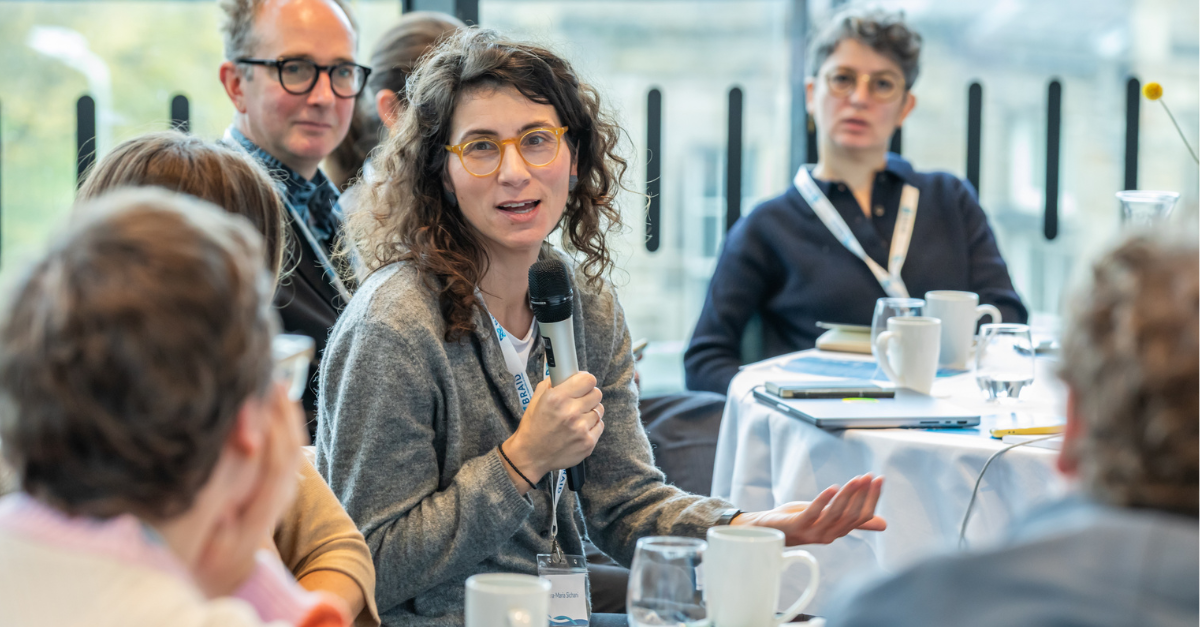
The academic-led pathway is designed to be a more recognisable approach to fellowships, where researchers with backgrounds from across the Arts and Humanities apply alongside their own collaborating non-academic stakeholder, having co-produced the research questions in advance.
We use the term non-academic stakeholders (NAS) to refer to non-academic project partners that have a demonstrable stake in the UK’s AI ecosystem. This can include organisations from the public, private or third sectors.
National Lottery Heritage Fund Challenge
In collaboration with The National Lottery Heritage Fund, we invite proposals to address how responsible AI can enhance the embedding of environmental considerations into heritage project design, maintenance planning and long-term sustainability.
Up to £120,000 is available for a research fellow to bring their unique disciplinary expertise to bear on the development of a prototype Environmental Impact Mitigation Tool for the heritage sector. This challenge is made possible through match-funding from the AHRC and The National Lottery Heritage Fund.
Framestore Challenge
In collaboration with Framestore, we invite proposals to address an Arts & Humanities-led enquiry into contemporary craftsmanship and the artistry behind digital production techniques in today’s visual effects studios.
Up to £120,000 is available for a research fellow to bring their unique disciplinary perspective to bear on telling the story of today’s artisans of the screen industry.
About the call
Aims, key objectives and overarching themes
Funding will support the following key objectives:
- Collaborative: Delivered in partnership with at least one non-academic stakeholder.
- Contribute to Responsible AI research and innovation: Broaden available research evidence on key issues/challenges within the ethics and responsible innovation agenda for AI.
- Produce novel research & non-academic impact: Produce novel research outputs with relevance and impact beyond the programme.
- Build new partnerships: Support the establishment of new multi-sectoral partnerships and networks.
- Support new capabilities: Support the development of new skills and capabilities.
- Progress the ecosystem: Take us closer to an arts and humanities-embedded AI ecosystem.
We have developed the following series of overarching workstreams to create coherence and purpose across the BRAID programme and delivery on our objectives. We ask that applicants address one or more of these themes in your proposals:
- Community and capability
- Recourse and repair
- Public media and democracy
While Responsible AI is widely recognised as a necessary aim alongside effective regulation, its meaning in AI development, use and governance remains unclear and contested beyond high-level appeals to ethical principles such as accountability, transparency, safety, justice or trustworthiness. Clarifying and demonstrating its full potential requires more than top-down principles; it requires bottom-up evidence grounded in concrete contexts of AI development and application.
Proposals must clearly speak to this aim for evidential groundwork and consider at least three of the following items:
- the potential for adoption and translation of existing responsible AI research, tools and practices into the project’s particular context (for example, algorithmic audits, impact assessments, red-teaming exercises, model cards, ethics review boards)
- the potential for new responsible AI knowledge, tools or practices to be developed in the context of the project, or adapted for this AI context from other domains or histories
- the barriers, opportunities and incentives to responsible AI in this context
- the network of actors, stakeholders, powers and interests in this context
- achievable goals and action-guiding criteria for responsible AI in this context
Successful proposals will also:
- integrate knowledge and practices from the arts and humanities into any appropriate research methods for achieving their goals and objectives;
- meet the key objectives and address one or more of the overarching work strands outlined in the below section entitled “Who Can Apply”; and
- demonstrate a commitment to public engagement and outreach, which we consider to be an important aspect of building a more robust responsible AI ecosystem in the UK.
In your application, you must clearly demonstrate:
- Broad knowledge of the area of interest and a compelling vision for the excellence and importance of your research project;
- Your own original and ambitious plans and ideas; and
- Alignment between the research proposal and the matters outlined above.
Applicants should set out a clear vision for sustainable legacy beyond the funding period. You are encouraged to consider your career development and support needs, including mentoring and professional training and development, and relevant training courses that will underpin your future career ambitions and learning. We encourage inclusion of a clear programme of skills development in the application so that we are aware of your goals and can support your needs in accordance with the principles of the Concordat to Support the Career Development of Researchers and the Technician Commitment.
We use the term non-academic stakeholder (NAS) to refer to non-academic organisations and businesses from the public, private or third sector that have a demonstrable stake in the UK’s AI ecosystem. For example, a large multinational technology company developing AI, a governmental body deploying AI in public services, a community group affected by algorithmic bias, or an association working to protect and manage property rights in training data.
BRAID defines Responsible AI as AI technologies being transparent, fair, accountable and beneficial to people and the environment. It includes an interdisciplinary field of research, a corporate governance agenda, a designed standard of AI products, and a broad ecosystem of stakeholders that continue to shape what “responsible” means in practice.
Who can apply
The BRAID fellowships are for researchers working in any arts and humanities discipline who want to work with a NAS partner on a research challenge and want to join a network of colleagues looking to drive developments in Responsible AI across the UK.
Before applying, applicants should check:
- your proposal is suitable for AHRC funding;
- the eligibility of your UK research organisation; and
- your eligibility as an individual.
To receive funding, you must be employed by, or have secured employment with, a UK research organisation eligible for AHRC funding for the duration of the research project. The one exception to this is where you already have an ongoing, substantial relationship with an institution (for example an emeritus or honorary position) that gives you the same practical access to management, infrastructure and support and would enable you to conduct the research as if you were an employee at the organisation.
Funding is available for research projects of up to 12 months in length plus up to an additional 3 months period for impact and engagement work with your NAS partner. Projects must start by 1 April 2027 and must complete by 30 June 2028 (including the additional 3 month period). No extensions are possible.
There is no requirement to hold a permanent position or for fellows to be appointed on a fixed-term basis. This is a matter for their research organisation and not a condition of eligibility. It is the research organisation’s responsibility to ensure that you have adequate time to work on your full submissions.
Scope of funding
At least 51% of proposed research must sit within the Arts and Humanities to be eligible. Please refer to the AHRC Remit, programmes and priorities page for more information.
We have approximately £620,000 in funding to award and anticipate funding around five projects.
Fellowships are not funded under fEC (Full Economic Cost) and only the following costs are eligible:
- Fellows salary, funded at 100% directly incurred
- Travel and subsistence, funded at 100% directly incurred
- Research related expenses, funded at 100% directly incurred
- Accessibility costs, as needed, funded at 100% directly incurred
- Mentor salary, plus estates and indirect costs, if applicable, funded at 80% fEC
N.B. Your research office will need to prepare the costing to attach to the application.
Research proposals may be built around a single project or a portfolio of smaller projects as required to meet your aims and deliverables. All requests must be appropriate to the project, and you must be able to justify the amount you need to meet the objectives of your proposal.
Eligible costs
Your budget should include the costs needed to sustain a working relationship with your NAS partner. Alongside working online, this may involve travel to visit your NAS partner at regular intervals. Your application should set out how the relationship will be managed, both in person and remotely.
Your budget should also include travel and accommodation costs for one trip to Edinburgh to attend a cohort enrichment event. All travel expenditure needs to align with standard university travel policies. See UKRI guidance for Travel Subsistence and Expenses Policy for guidance.
Salary costs are for the fellow’s salary and applicable on-costs (e.g. National Insurance, pension), excluding estates, indirect costs or other overheads.
Research related expenses can include things like software licences, subscription costs, cloud hosting and compute costs, access to third-party datasets, user testing or accessibility auditing, specialist technical or engineering consultancy and subcontracted support such as design and production services. It also includes things like venue hire, materials, AV/IT equipment hire, facilities charges, dissemination, and publication costs. Note that fellowships are primarily intended to build individual capacity. Depending on the project, an appropriate and proportionate allocation for research staff may also be included where clearly justified to complete defined tasks.
To support BRAID objectives to engage with underserved or underrepresented groups in the responsible AI ecosystem, in some cases specific, clearly defined pieces of work delivered by NAS partners (e.g. running co-design workshop or leading community engagement activity) can be costed as subcontractor fees and paid from the grant under Research related expenses. The subcontracted task needs to be separate from the collaborative nature of the partnership itself and should comprise distinct, scoped deliverables with clear outputs. A subcontract to the NAS partner is more likely to be justified where: the organisation does not have spare unpaid capacity to deliver the specific task without displacing its own core service delivery (particularly relevant for small charities and community organisations); the task is well defined; the partner uniquely placed to deliver; and the reasons for subcontracting in this way are clearly justified and explained in the proposal. Where a NAS partner is able to resource the task through an in-kind time or cash contribution this remains the default and preferred route, consistent with the expectation that all budget requests represent the optimal use of available funding.
Accessibility costs include things like BSL/sign interpreters, live captioning, audio description, accessible formats, access support workers, specialist transport, childcare and carer support for participation.
Please contact braid@ed.ac.uk with any queries you might have in relation to the budget proposal.
Time expectations and buyout
We generally expect fellows to commit 100% of their working time (FTE) to the fellowship but recognise that this is not always possible.
Fellows may request to undertake the fellowship on a reduced-hour basis where this is needed to sustain other career or life commitments. Bear in mind that the fellowship must be completed within the funding period and costs relating to time spent on other commitments cannot be claimed. A minimum of 40% FTE is allowed where circumstances warrant it.
Additional impact and engagement work
To accelerate impact from projects, we will fund an additional 3-month period to the fellowship’s 12-month duration to facilitate additional impact and engagement work after project completion. There is no minimum time commitment or FTE requirement for this extended 3-month impact acceleration period. This additional funding is designed to support specific impact and engagement activities. These should be set out in the Project Plan and milestones section of your Case for Support. Your project plan should include clear and specific milestones for this period reflecting the impact and engagement work you or your NAS partner intend to deliver, even if your own FTE contribution by that point is minimal.
Please email braid@ed.ac.uk if you would like to discuss these arrangements prior to submission.
Early career researchers, mentoring and support
We encourage applications from early career researchers as broadly defined by the AHRC, with permission from your line manager and provided your post outlasts the project. You will need to hold a doctorate by the time you take up the fellowship (and this includes applicants who have submitted a doctoral thesis for viva voce examination before the application deadline) or have equivalent professional training and experience.
Appropriate support and mentoring will need to be put in place to support your professional and career development. Early career researchers should ordinarily be paired with a mentor at your research organisation and mentoring time of up to one hour per month can be included in the budget. Applicants at other stages of their career may also include mentorship if it would benefit the project.
Equality, diversity and inclusion
This call is committed to equality of opportunity and seeks to amplify under-represented voices in Responsible AI. Both the AHRC and the University of Edinburgh have a long-standing commitment to equality, diversity and inclusion and to promoting a positive culture, which celebrates difference, challenges prejudice and ensures fairness. We welcome applications from research-active staff at all career stages and particularly encourage applications from marginalised and under-represented groups.
We support people to work in a way that suits their personal circumstances. This includes:
- career breaks;
- support for people with caring responsibilities;
- flexible working; and
- alternative working patterns.
During both the application and delivery stage, if you require additional support relating to accessibility please contact braid@ed.ac.uk or alternatively our operations manager Tina Donnelly (tina.donnelly@ed.ac.uk) to discuss how we can best support you. Financial support to remove barriers to participation is available via the separate BRAID accessibility fund, rather than being drawn from your project budget. Any request will not affect your assessment and you can write to us at any time pre or post submission
You can find more information at UKRI’s equality, diversity and inclusion pages and at the University of Edinburgh equality, diversity & inclusion pages.
How to apply
There are two routes to apply:
The academic-led route takes a more traditional academic format, where applicants identify their own Responsible AI challenge and secure the support of an NAS partner to deliver the project.
For the challenge-led route, applicants choose to address one of two Responsible AI challenges set by The National Lottery Heritage Fund and Framestore and published on the BRAID website.
We ask that applicants submit a simple Expression of interest at your earliest convenience and by Friday, 23 October 2026. This helps us monitor demand and identify suitable panelists ahead of the full application deadline. For challenge-led applications, it also gives you the opportunity to briefly outline your proposed approach and flag any specific key requirements needed to deliver the project (e.g. access to particular data or resources without which the project is unworkable) so that we can check the feasibility of these things with the NAS partner prior to completing your submission. You can also use this stage to raise any queries around working arrangements or budgetary matters.
The application form must be submitted by 5pm (GMT) Thursday, 5 November 2026.
Attachments to application
All applications are required to include:
- Letter of Support (LoS) from your research organisation. The LoS must be signed by an authorised signatory (e.g. Head of Research Office, Pro Vice-Chancellor Research, or equivalent) and should confirm: clear statement of support and detail why the proposed work is needed; institutional commitment to hosting the fellowship; and compliance with the guidance notes. A template for this letter is provided on our Fellowships call page.
- Research Office Costings prepared by your research office.
- CV, which can but does not need to take the form of a narrative CV.
Academic-led applications are also required to include an additional LoS from their nominated NAS partner. This letter should confirm the stakeholder’s commitment to the project in line with this guidance note, clearly explaining the value, relevance and possible benefits of working together, and describe any additional value that they bring to the project. A template for this letter is provided on our Fellowships call page.
Challenge-led applications do not require a LoS from their NAS partner.
Working arrangements
To enable successful collaborations, NAS partners must commit to:
- work with you to refine your project plan and agree on shared goals and outcomes, and suitable working arrangements;
- an onboarding process to introduce you to the partner and connect you with relevant people and contexts;
- to jointly deliver at least one project output;
- providing a key point of contact for you to engage with throughout the programme with a recommended time commitment of at least 10% FTE (i.e. half a day each week) with additional contributions and support being welcome and encouraged;
- office space and access to IT facilities as appropriate, with opportunities to meet on site when needed alongside online working arrangements; and
- a collaborative and supportive environment.
These commitments have been developed to signal that we are looking for genuine, substantive collaborations and exceptions can be made where the requested commitments present barriers to participation for underrepresented and underserved stakeholders. For example, the recommended minimum 10% FTE time commitment represents a signal that the BRAID fellowships are designed to be based on genuine, substantive collaborations. Where a NAS partner, such as a small charity or community group, is unable to sustain this level of commitment unpaid over the course of the entire project, you may propose a reduced commitment or otherwise limit the time commitment to key project stages and milestones rather than spread it across the entire project’s duration. Alternatively, there may be other ways to demonstrate the partnership’s substance through other means, such as clear pathways to impact or defined key co-delivery commitments. Proposals should be explicit and specific about what the partnership involves and why that level and shape of commitment is right for the project and the partner, rather than defaulting to standard commitments without thinking through or explaining what the project requires for its success.
Challenge-led applicants should refer to the relevant challenge-specific guidance notes for more information about working arrangements and expectations.
If your application includes an international NAS, the site Trusted Research contains useful information on effective international collaboration.
For successful applicants, a formal collaboration agreement incorporating the NAS partner commitments and agreed project plan must be put in place once an award is made and prior to the project beginning.
Beyond working with your NAS partner, fellows will also be invited by BRAID to join monthly online cohort support meetings and other activities to build networks across the cohort and wider programme, including one in-person cohort event, along with opportunities to promote your work.
Intellectual Property arrangements
We want to ensure that everyone’s intellectual property (IP) is protected and, where possible, that research funded under this call can in time be appropriately commercialised. In line with BRAID and the AHRC’s commitment to open and responsible AI research and innovation, we expect IP arising from the fellowships to be made available to the public domain under free licence for research and teaching.
Parties retain their background IP (the assets and data they bring to the research project, not including things like open-source data sets). IP created by you during the fellowship (foreground IP) will usually rest with the fellow’s research organisation as publicly funded research outputs.
Alongside the publication of research papers, you and your NAS may also work collaboratively on shared outputs to accelerate impact on the field of Responsible AI in the contexts in which the project operates. Where a partner is match-funding a fellowship, a tailored IP approach can be adopted. Please check the additional guidance for challenge-led applications and contact braid@ed.ac.uk if you have any queries.
Appropriate collaborative agreements must be put in place between your research organisation in negotiation with your NAS partner prior to the commencement of the fellowship to enable this work. A copy of the completed collaboration agreement is to be emailed to braid@ed.ac.uk within the first 8 weeks of the project commencing.
After the fellowship ends and where appropriate, we encourage fellows to work with their research organisation’s commercialisation team, to explore ways of accelerating the impact of your work through commercialisation routes that build on the project outcomes. In collaboration with Edinburgh Innovations at the University of Edinburgh, BRAID seeks to encourage and promote such developments as a way to support leadership and strengthen networks across the private, public and third sectors.
The BRAID team is happy to discuss IP arrangements at any stage. Please contact braid@ed.ac.uk.
Research integrity and responsible innovation
Ethical research and innovation, research integrity and responsible innovation are all expected to be core considerations for all proposals. We encourage you to look at the Good research resource hub and the framework for responsible research and innovation published by UKRI in this regard.
By submitting an application, you confirm that you are aware of and will comply with relevant legislation, regulations and ethics guidelines. This includes obtaining ethics approvals from your research organisation, adopting appropriate safety and security measures, running necessary due diligence checks on external project partners, and embedding your research organisation’s equality, diversity and inclusion principles and sustainability practices.
Responsible innovation should be embedded in projects from the earliest stages and throughout the project’s lifetime. Applicants are encouraged to consider the future directions of their proposed research and anticipate societal consequences, regularly reflect on assumptions, and integrate diverse perspectives into strategic decision making. We encourage researchers to engage with end-users to understand their needs and achieve beneficial impact by obtaining a broader understanding of how desirable different impacts will be for different public and stakeholder groups.
Applicants should demonstrate in their application how they will ensure the alignment of intended impact with societal benefit and public interest. Project impacts should be socially desirable and in the public interest, while also accounting for environmental sustainability and social justice.
Application to Award Process
The application process aims to give applicants the opportunity to refine concepts and ideas into fundable research projects that, if successful, will be delivered in collaboration with NAS partners.
Researchers can submit one application only. The funding call closes at 5pm GMT on Thursday, 5 November 2026. You will not be able to apply after this time.
Before submitting your application:
- consider opportunities to attend information session and drop-in sessions, review the guidance notes and additional FAQs on Fellowships call page, gain the support of an NAS partner (if academic-led) and research organisation, and have your research office produce official costings for the budget;
- please complete an expression of interest by 23 October 2026.
We will hold an information session on Thursday 17 September 2026 at 9.30am (BST) and recordings will be made available online. You can also book to attend a drop-in session to speak with the BRAID team. All pre-submission processes, including expressions of interest and drop-in sessions, do not form part of the assessment process and simply support the preparation of applications while enabling us to plan for the review process.
Post-submission process
Following an office check stage to ensure each application meets eligibility, funding, and NAS requirements, a selection panel of subject and sector specialists will be put in place, with input from the AHRC and the University of Edinburgh. The panel will convene in mid-December 2026 to collectively review your application against the criteria and rank it alongside other applications. In the case of applications under the challenge-led model this is an additional stage: NAS partners and BRAID will interview top-ranked applicants prior to issuing the award.
We reserve the right to use the funding recommendations to create a balanced portfolio of projects, considering the diversity of teams, research themes, and geographies in that process.
Please note that the decisions of the BRAID Review Panel will not be open to appeal and the University reserves the right to amend the application process.
We intend to communicate outcomes by mid-December 2026. Successful applicants will then be invited to enter contracts between your research organisation and the relevant NAS partner to enable the project to commence.
While participating NAS partners are championing the fellowships scheme, they are independent organisations. These organisations reserve the right not to enter into collaboration agreements where the parties cannot ultimately agree on shared goals and outputs or where issues surrounding access to data and IP arrangements prove unworkable. In the unlikely event that this occurs, we will work with successful applicants to find a suitable replacement organisation where possible, so that the fellowship can proceed.
Governance
The BRAID Review Panel has academic and external representation drawn from the University of Edinburgh, the AHRC’s Peer Review College and our programme partners, and industry representatives. Panelists who are involved in any application or otherwise have a conflict of interest will be required to declare the conflict and will be recused from decision-making.
Reporting and monitoring post award
Successful projects will be expected to provide regular reports, participate in regular cohort support sessions, and update on project budget, progress or any significant changes to the submitted proposal.
Milestone and Responsible Innovation Review Meetings
Each project is to include milestone review meetings, coinciding with project milestones, and one responsible innovation peer learning session. The review meetings will be attended by you, the NAS partner and members of the BRAID team. At these milestone review meetings, you will be expected to disclose data supporting milestone progression and in addition to spending totals to date. The BRAID programme team will confirm milestone progression. The peer learning session on responsible innovation will include presentations and discussions from the cohort about their approaches and relevant considerations and will be required for milestone progression.
Early termination of a project
We reserve the right to terminate projects that have not made sufficient progress, have failed or are judged unlikely to achieve milestones. The decision to terminate a project will only be taken following a full discussion between the BRAID’s programme team and the relevant parties. In the event of a project being terminated early there is an expectation that unspent funds will be returned to the BRAID fund for reallocation in a timely fashion.
Final Review Meeting
Within 1 month of the project concluding you will be expected to have a final review meeting attended by the BRAID programme team and representatives of the AHRC as well as your NAS partner. You will be expected to disclose data supporting the project outcomes in addition to spending totals. You will also be expected to submit a Final Report summarising the data supporting milestone achievement and project outcomes.
Annual Reporting
In keeping with the BRAID programme objectives to build and nurture the development of responsible AI research infrastructure and create a collegiate network of responsible AI researchers, we will expect you to provide project updates when requested and provide data on outcomes annually for up to 5 years after the award has completed. Failure to provide timely reports goes against the ambitions of the programme and would result in you being prejudiced from submitting applications to future programmes.
Data Management
Privacy and data protection:
We will need to collect some personal information to manage the application process and the registration of your funding applications. We are using this information because by applying you initiate steps to have your research proposal considered for funding and if awarded, personal information will be used to enter into a contract with the University. For successful applications, we will hold the personal data you provide to us for as long as the AHRC requires us to. Unsuccessful applications will be kept for minimum of 2 years from the closing date of 5 November 2026. We do not use profiling or automated decision-making processes.
Successful projects will be required to work with BRAID’s Programme Directors, who will:
- connect the funded projects with each other as appropriate;
- enable access to the programme’s network and activities; and
- provide funded applicants with opportunities for broader networking.
The following details of the successful projects may be shared with the wider BRAID network:
- project name and contact email;
- fellow’s name and contact email;
- a contact name and email for the non-academic stakeholder; and
- case for support.
The summary proposal of successful projects may be published on the BRAID website.
How we will use your personal data
Your personal data will be handled in line with UK data protection legislation and managed securely, in accordance with the University of Edinburgh’s data protection policy.
Project data
As data generated during the lifetime of a research project may be required to support future funding applications, IP, legal agreements, regulatory applications or commercial due diligence, it is important to ensure implementation of good data management practices. You are responsible for ensuring consistency and quality in data capture, storage, management and protection in adherence to your research organisation and UKRI policy. Applicants should outline in their applications how you will comply with the UKRI’s Data Sharing Policy, which contains useful guidance. Further information and advice can be obtained through your research organisation. For example, see the University of Edinburgh’s Research Data Service and the University Research Data Management Policy.
Application Form
The application process is strictly confidential between the applicants and the funding panel to prevent the disclosure of unprotected concepts.
We must receive your application by 5pm GMT time on Thursday, 5 November 2026. You will not be able to apply after this time.
You will need to complete all required sections and attach all required supporting documents to the application form. Please ensure that everything is completed in plain English.
For help on writing your application, please contact your research office, who will also need to prepare your costings and Letter of Support.
The application form is an online form available through Jisc. Applicants should work from a word version of the form, which includes the case for support attachment, when drafting their submission. The word version is available on our Fellowships call website.
The form is divided into 6 main sections. Sections 1, 2 and 4 can be answered directly into the text boxes provided on the online form. You can save your answers and come back to them; however, we recommend working on the offline form in the first instance. Sections 3 and 5 are to be uploaded as PDF files.
Section 1. Applicant and project details
Details of the project lead and their HEI contact; your NAS partner (academic-led or challenge-led as applicable); mentor details, if applicable; and project details, including proposed dates, total funding requested, and the overarching work stream(s) addressed. This information is to be entered directly into the text boxes provided on the online form.
Section 2. Project Summary
Responsible AI challenge (max. 400 words); Areas of interest (max. 150 words); and Alignment with BRAID (max. 200 words).
Section 3. Case for support
Use the template from our application form and upload the completed document. Max. 6 x A4 pages, 11pt Calibri font. Note that this limit excludes the Reference list as well as the Project Plan and Milestones table.
Topics to cover: Research challenge and why it matters now; Approach and methodology; Partnership model; Contingency planning; Impact and legacy; Responsible research and innovation; Mentorship and support; References; Project plan and milestones.
Section 4. IP and Data Management
Outline any background IP the project will rely on or need access to and confirm this can be secured on reasonable terms. Describe what types of data the project will collect or generate and how this will be managed. Outline what new IP you expect to create and how this will be managed. This information is to be entered directly into the text boxes provided on the online form. Max. 500 words
Section 5. Budget
Note that the detailed costings prepared by your Research Office must be attached separately.
The summary table of funds requested should include totals for each budget category only, not a breakdown of individual items. Mentor costs are funded at 80% Full Economic Costing (FEC); all other budget categories are funded at 100% of direct costs (not FEC).
Use the justification of resource section (max. 1,200 words) to detail what resources you will require to carry out your proposed research and how much each resource will cost. All requests should be:
- comprehensive, appropriate, and justified;
- represent the optimal use of resources to achieve intended outcomes; and
- maximise potential outcomes and impact.
For some items, we do not expect you to justify the monetary value but rather the type of resource, such as the amount of time or type of assistance requested. Where you do not provide adequate justification for a resource, we may deduct it from any funding awarded. You should include the following items:
- travel and subsistence costs to enable collaboration with your NAS partner;
- expenses related to research activities and responsible innovation, including support for activities to increase impact, public engagement, knowledge exchange and publications; and
- support needs such as accessibility and mentorship costs.
Section 6. Additional attachments
This section serves as a checklist to ensure all the required attachments to support your application are included in your submission. See ‘How to apply’ above for more information about attachments.
- Letter of support from your Research Organisation.
- Letter of support from your Non-Academic Stakeholder (for academic-led applications only)
- CV
- Research Office Costings
Section 7: Signature
Confirm that the information given in your application is accurate and complete to the best of your knowledge, and that you have read and will comply with the guidance notes.
Assessment Criteria
The BRAID Review Panel will consider outline applications against the following criteria:
Vision—Have the applicants demonstrated how the work they are proposing:
- integrates arts and humanities research into the given context and meets the aims, key objectives and overarching themes of BRAID
- makes the case for why their NAS is an appropriate partner (for academic-led applications) or why the project is a good fit to address the challenge posed by the NAS participating in the call (for challenge-led applications)
- is of excellent quality and importance, with potential to advance current understanding, knowledge, or thinking within or beyond the field or domain area
- is timely given current trends, context and needs and will inform future research or interventions in the space of responsible AI
- will impact world-leading research, society, the economy or the environment
Approach—Have the applicants demonstrated that they have designed their approach so that it:
- is effective, appropriate and, where applicable, uses clear and transparent methodology to achieve their objectives
- describes how their research environment (including its fit in the context of their NAS partner) will contribute to the success of the project
- is feasible, identifies risks to delivery and how they will be managed and, where applicable, builds on previous relevant work
- will maximise translation of outputs into relevant outcomes and impacts
Capability to Deliver—Have the applicants provided evidence of how they have:
- the relevant experience (appropriate to career stage) to deliver the proposed work
- the right balance of skills and expertise to cover the proposed work
- have an appropriate NAS partner organisation that has aligning values, capability and expertise to support the fellowship (academic led only)
- the appropriate leadership and management skills to deliver the work and their approach to develop others
- contributed to developing a positive research environment and wider community
Resources and Cost Justification—Have the applicants demonstrated how the resources they anticipate needing for their proposed work:
- are comprehensive, appropriate, and justified
- represent the optimal use of resources to achieve the intended outcomes
- maximise potential outcomes and impacts
Ethics and Responsible Research and Innovation (RRI)—Have the applicants identified and evaluated:
- the relevant ethical or responsible research and innovation considerations and how they will be managed
- the relevant equality, diversity and inclusion (EDI) considerations and how they will be managed
FAQs
Does my research need to sit entirely within traditional Arts and Humanities disciplines or can I use methods from other fields such as the social sciences?
Flexible, interdisciplinary approaches are expected and welcome. The boundary between Arts and Humanities research and adjacent fields such as the Social Sciences is often difficult to draw precisely and we welcome methods from outside core Arts and Humanities disciplines where this is required to meet your project’s objectives. Similarly, if your own background is primarily within a field such as engineering or computer science, what matters is that at least 51% of the underlying research in your proposal sits within the Arts and Humanities. See the AHRC’s Remit, programmes and priorities page for more information.
Is the call open to international collaborations or does the work need to be UK-focussed?
While you need to be based at a UK research organisation, the project itself doesn’t need to be UK-focussed. International collaborations with stakeholders from overseas are welcome. Your proposal should set out clearly how the collaboration will be conducted at a distance and where possible include one or two in-person visits to strengthen the partnership and support delivery.
I’m not currently working in academia. Can I still apply?
Yes. You don’t need an existing research affiliation to apply. What is required is that a UK research organisation eligible to receive AHRC funding commits to employing you to undertake the project for its full duration. This commitment needs to be confirmed in a letter of support. There’s no requirement for the post to be permanent or fixed-term specifically. The one exception to this is where you already have an ongoing, substantial relationship with an institution (for example an emeritus or honorary position) that gives you the same practical access to management, infrastructure and support and would enable you to conduct the research as if you were an employee at the organisation. See UKRI’s Individual eligibility page for more details.
What counts as early career researcher for this call?
The funding opportunity is not limited to early career researchers. Rather, the call includes provision for mentoring that is geared towards supporting early career researchers. Following the AHRC’s approach, there is no simple cut-off for what constitutes an early career researcher. Instead, we use a broadly self-identified approach that prioritises needs-based professional development over strict metrics like years post-PhD. If helpful, someone within eight years of being awarded their PhD (or equivalent professional training) or within six years of their first academic appointment can usually be considered an ECR, although the breadth of the research community and diverse career paths mean that such definitions can be of limited use.
Is this call mainly aimed at early career researchers or can anyone apply?
Anyone can apply, regardless of career stage. Our cohort includes people at a range of career stages working at a range of time commitments.
Do I need to hold a PhD to apply or can ‘equivalent research experience’ count instead?
Following AHRC’s own standard approach, a doctorate isn’t strictly necessary and ‘equivalent professional training and experience’ is a basis for eligibility. There is no fixed definition of what counts and applicants must make the case for why your background (e.g. sustained track record of independent research or professional practice, relevant publications or outputs, recognition within your field) is equivalent to doctoral-level training and experience. The panel assess that case on merits.
Can I undertake the fellowship part-time e.g. alongside existing teaching commitments?
Yes, there’s flexibility here. We generally expect fellows to commit 100% of their working time to the fellowship but recognise that this isn’t always possible including the need to sustain other commitments such as teaching. A minimum of 40% FTE is allowed where circumstances warrant it. Bear in mind that the fellowship still needs to be completed within the fixed project period (by 30 June 2028) regardless of your FTE and costs relating to time spent on other commitments can’t be claimed from the grant.
Is there any flexibility if I need to take a period of leave e.g. maternity leave during the fellowship?
Yes, we follow standard UKRI model here which allows flexibility to cover parental leave by placing the fellowship in abeyance during the absence and extending it by the period of leave taken.
For the Framestore challenge, do I need existing experience or knowledge of AI in professional production pipelines?
No, there’s no prerequisite for prior professional VFX or production experience. The challenge welcomes a range of disciplinary perspectives, including practice-based, historical and philosophical approaches, and asks for knowledge of or a willingness to engage in depth with the computational processes involved in digital production. Having existing craft knowledge of VFX isn’t required and won’t exclude you, although in some way a basic understanding would be an advantage.
What kinds of organisations count as non-academic (NAS) partners?
A NAS partner can be any non-academic organisation with a demonstrable stake in the responsible AI ecosystem, from the public, private or third section. This includes large multinational companies, small charities, community groups, government departments and membership or representative bodies. What matters is that the partner can demonstrate genuine involvement and interest in responsible AI relevant to your project.
Can I include more than one NAS partner, for example two charitable organisations, or is one partner the expectation?
We are open to supplementary NAS partners where the project calls for this and where these partners still deliver against the selection criteria and there remains one primary NAS partner. This may make contracting and collaboration agreements more involved and any additional complexity or impact on the project should be worked into your proposal.
Can the same NAS partner support more than one fellow including fellows at different institutions?
Yes, there is nothing in our guidance that prevents this from taking place. As to whether more than one of these projects would be successful, there is capacity at the selection stage for a portfolio approach that seeks to ensure we have a spread of projects working with different partners, in different domains and in different locations.
Does the NAS partner’s 10% FTE commitment need to be provided by one named person, or can it be split across several members of staff?
While there should be one identified lead at the organisation, there is flexibility here and the minimum time commitment can be shared across the organisation from time to time according to the needs of the project.
Does my research office need to budget for NAS partner’s 10% FTE commitment or does the partner provide that separately?
The NAS partner’s time is an in-kind contribution from the partner, not a cost paid for out of the fellowship budget. The NAS partner should set out the estimated value of their in-kind contributions in their letter of support.
I am wanting to partner with a small charity that will have difficulties financially committing to the 10% FTE standard commitment for the named point of contact. Is there flexibility here?
The 10% FTE guideline is meant to provide a signal that we are looking for genuine, substantive collaborations rather than token partnerships. It is not a fixed requirement every partner must meet regardless of size. Where small charities or community groups are not in a position to sustain that level of commitment financially, it’s fine to propose a reduced time commitment or to concentrate that 10% FTE time commitment at specific points in the project rather than spreading it evenly across the whole duration.
It’s important to note that applications can also demonstrate a meaningful partnership in other ways such as clear co-delivery commitments or well-developed pathways to impact that show how the partner’s involvement will shape and benefit from the work.
What matters most to the panel is that proposals are explicit and specific about what the partnership actually involves and why that level and shape of commitment is right for the project and the partner, rather than defaulting to the standard commitments without thinking through and explaining what the project requires for its success.
Can a small partner organisation be paid for part of their contribution rather than providing it entirely in-kind?
This is possible in some cases, especially where you are working with underrepresented groups and smaller organisations in the third sector. Where a project partner’s general collaborative role is provided in-kind, a specific, clearly defined piece of work that they deliver (e.g. running co-design workshop or leading community engagement activity) can be costed as a subcontract and paid from the grant, rather than claimed as an in-kind contribution.
This isn’t a substitute for the partnership itself or available in all cases and requires careful consideration and justification. The subcontracted task needs to be a distinct, scoped deliverable with its own clear output and the need for it being subcontracted in this way should be explained and justified in the application. Where a NAS partner is able to resource the task through an in-kind time or cash contribution this remains the default and preferred route, consistent with the expectation that all budget requests represent the optimal use of available funding.
A subcontract to the NAS partner is more likely to be justified where: the organisation does not have spare unpaid capacity to deliver the specific task without displacing its own core service delivery (particularly relevant for small charities and community organisations); the task is well defined; the partner uniquely placed to deliver; and the reasons for subcontracting in this way are justified and explained in the proposal.
If my NAS partner is hosting or running an event, lab or public activity as part of the project, can that be budgeted for?
Yes, specific costs tied to a project activity such as venue hire or materials are eligible under the research related expenses budget category, funded at 100% directly incurred, provided they’re clearly justified. Bear in mind that where possible we encourage project partners to provide in-kind and cash contributions to the project that enhance the level of resources brought to bear on delivering project outputs.
For challenge-led applications, is the NAS partner involved in reviewing and ranking applications? And is there scope to define my own approach within the challenge?
Yes, there’s considerable flexibility to define your own approach and methodology within your nominated challenge. Projects are assessed on how well they address the challenge and not on matching a particular approach. On the NAS partner’s role in assessment, NAS partners are not part of the panel that reviews and ranks applications and this review is carried out by the BRAID panel alone. For challenge-led applications specifically, the NAS partner will interview top-ranked applicants after the panel’s ranking before an award is issued.
Do challenge-led applications need to submit a letter of support from their NAS partner (e.g. Framestore or The National Lottery Heritage Fund)?
No, the letter of support from your NAS part is only required for academic-led applications, where you’re nominating your own partner.
Can an early career researcher work with a senior academic as a mentor? Can my PhD supervisor be my mentor?
Yes, previous PhD supervisors make for excellent mentors. All early career researchers are encouraged to pair with a mentor at their research organisation as a way to support professional and career development.
Does the mentor have to be based at the same institution or can they be from elsewhere?
Mentors are ordinarily expected to be based at your research organisation and form part of the support provided by the organisation. However, our guidance doesn’t rule out an external mentor. We recommend writing to braid@ed.ac.uk if you’re planning to include an external mentor to discuss arrangements prior to applying.
Does the mentor need to be an academic or could they be a different kind of specialist?
The guidance doesn’t require the mentor to hold an academic position specifically. What matters is that they can support your professional and career development.
Can I hire a research associate as part of my fellowship?
Yes but not in the way a standard research grant might allow. Fellowships are designed for individual researchers to lead and carry out the project and so they are expected to undertake most of the proposed research activity themselves. That said, your budget can include the cost of research assistants or associates for example to undertake a short period of research or provide technical or other expertise that supports specific, clearly defined tasks within your project, provided in each case the cost is properly justified.
How developed does my relationship with my NAS partner need to be by the time I apply?
Developed enough that you can demonstrate through your application a viable and feasible project plan with accompanying letter of support from your NAS partner that sets out how they intend to support delivery of the project. A template letter of support is available on our Fellowships call page to help structure this.
Are the application forms different depending on which call or challenge I’m applying under?
No, there is a single application form for all routes.
How does BRAID define ‘responsible AI’ – is it about the AI itself being responsible, or how it’s developed or how it’s used?
As set out in the guidance note, BRAID takes a broad view of responsible AI that spans all of these things: design and development of AI systems, the way they’re deployed and used, as well as wider governance, oversight and accountability structures. Projects can engage with any of these dimensions or several together.
What would make a project particularly compelling to the selection panel?
Projects that address the selection criteria and combine a clear, timely rationale for why the research matters now with a well-positioned NAS partner with genuine fit as well as a realistic, well-scoped plan for delivery.
What does a fellow bring to a NAS partner that a contractor doesn’t?
A research fellow brings independence and subject-specific depth. Unlike a contractor delivering to a defined brief, fellows bring Arts and Humanities knowledge and expertise to a particular organisation, creating a space for genuine collaborative developments by asking questions and offering solutions that a commissioned piece of work is less prone to surfacing. Fellows are also embedded in a wider BRAID cohort and community, which can bring additional value back to the partner beyond the individual project itself.
How can organisations get involved as a potential NAS partner?
If your organisation is interested in partnering with a BRAID fellow, we encourage you to post your interest publicly and tag BRAID on LinkedIn, Blusky or Instagram, as a way to connect you directly with our community of researchers. Please also email us at braid@ed.ac.uk and let us know about your interest so that we can help make sure prospective applicants are aware.
Call updates
Update 30 September 2026: Following feedback, we’ve extended the deadline for the expression of interest (previously called the intention to submit) to 23 October 2026. Submitting one is no longer a requirement for eligibility, but we still encourage applicants to submit one as early as possible as it helps us manage workloads and plan the selection process.
We also updated eligibility guidance around your employment status at the research organisation to include eligibility for applicants that satisfy UKRI’s ‘substantial relationship’ test and updated the letter of support for research organisations to better align with the template on the Fellowships call page.
Update 1 October 2026: Following feedback on partnering with small charities and community groups, we’ve adjusted the guidance and template letter of support for NAS partners to enable greater flexibility where needed. We also provided additional guidance around engaging these types of NAS partners as subcontractors in order to deliver specific, clearly defined pieces of work as Research related expenses.