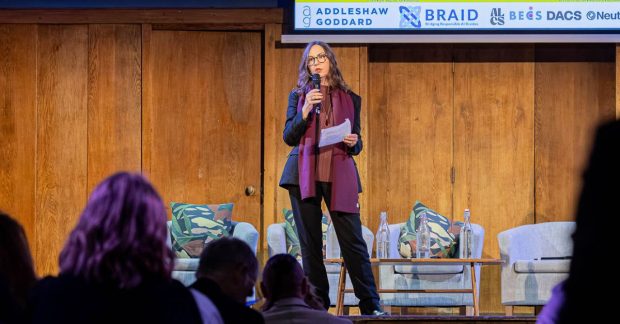
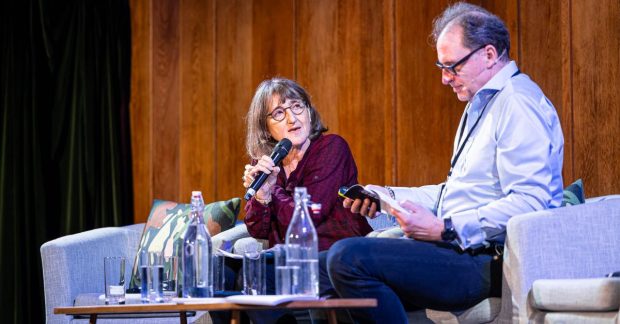
Professor Shannon Vallor at the Creators Emergency Summit. Image credit: Ozzy Nada.
In recent weeks, two events on both sides of the Atlantic have led me to reflect on the misnomer that is the common phrase ‘power to the people.’ The problem is that second little word: to. It implies that the power rests elsewhere, and that the people have to wait for it to be delivered to them.
The misguided question that phrase invites is: ‘will the people be given power to change things, and when?’ In reality, people—not as solitary individuals, but as publics—always already hold the power. The power is from the people. The right question is: ‘when will the people be moved to use their power, together, in defense of one another?’
This is hardly a new insight. None of us would live in a democracy today if people needed to wait for the power to govern themselves to be given to them. Yet no matter how many times we witness the power of human solidarity in action—not the forceful taking of power but its joint use for mutual aid and defense—we keep getting trapped by the first, misguided question.
So many talks I have given and attended over the past three years have ended with a Q&A mired in this position of helpless waiting. These are conversations that challenge the demand for responsibly designed and governed technology by asking how one could possibly tackle this problem when all the power is held by the US, or by a handful of Silicon Valley companies, or by the convenient bogeyman called Late-Stage Capitalism.
The form of the objection varies, but the logic is always the same: “Sure, in an ideal world, our rights and the public good would matter more than power and profit for a few. But here in the real world, those with the power will always act in their own interest. So what can we possibly do?”
***
On 13 October 2026, I had the honour of addressing all those gathered at the Creators Emergency Summit, a day-long meeting of UK creators and others working to support the health and vitality of our creative sector, from policymakers and legal experts to authors, musicians, photographers and creative tech developers.
Organised by Charting GenAI journalist Graham Lovelace, the event confronted what many creators see as an existential threat from AI: not the fanciful Terminator scenario, but the grim reality of watching creative opportunities and economic power drain out of your sector as large AI platform companies flood the market with generative AI tools unjustly trained – without consent, credit or compensation – upon your community’s labour, craft and visions.
You can read thoughtful writeups of the event from Charting GenAI and participating organisations like ALCS and the Independent Society of Musicians, so I won’t summarise the events of the day, which featured panels and interviews with those using policy, legal action, campaigns, labour organising and tech tools to defend the legal rights and moral and economic interests of UK creators.
I kicked off the afternoon, welcoming the audience back from lunch on behalf of our AHRC-funded research programme BRAID (Bridging Responsible AI Divides), a principal sponsor of the event along with law firm Addleshaw Goddard. In my remarks, I said:
Today’s conversation is driven by, and for, those whose livelihoods and rights have been unjustly sacrificed to the so-called ‘AI revolution’. Good revolutions, just revolutions, liberate and empower people. They do not extract our power and deny our agency. But today is all about agency. This summit is not a passive rehearsal of grievances. It’s an active construction site of resistance, of community defense and mutual aid, and of strategic planning for renewal of the UK’s creative power—power that lives in this community, not in Silicon Valley.
Baroness Kidron OBE and Graham Lovelace at the Creators Emergency Summit. Image credit Ozzy Nada.
I’d prepared these remarks in advance, but I’d been thinking all morning about their resonance with the message of Baroness Kidron OBE, whose interview with Graham Lovelace started the day. She talked about the need to find community consensus: not a perfectly harmonious pact on exactly the right place to end up, but an imperfect collective agreement to all start pushing forward. She pointed out that a lot of people doing a little, but moving together, can bring about as much or more change than a handful of people doing a lot. The Summit showcased many people—legal advocates, campaigners, organisers—already doing a lot. It’s time for the rest of us to get moving.
We know that this is how democracies get a mandate; for as Baroness Kidron said, we’re the ones who give it. The power is always with us. The question is whether we have a consensus that it’s time to use it to move, and the wisdom to know the general direction.
***
I write this as a British citizen born and raised in the US, on the morning after the US 2026 midterm elections. A vast number of US voters, spread across cultures, age groups, economic classes, and thousands of miles, decided it was time to move. And while they still don’t agree on exactly the right place to end up, there is a growing national mandate on the general direction: away from authoritarian politics’ partnership with Big Tech’s unaccountable and unelected powers, and toward a future where human agency, opportunity and creativity aren’t replaced by data centres, but still living in our hands. On display at the Summit, on stage and in the audience, and alive all throughout our BRAID network, is that very same power.