UK/US Collaborations

Seven new projects will establish and strengthen collaborations between US and UK researchers in research that will address the ethical, legal and societal implications of artificial intelligence (AI).

Funded by UKRI and delivered through the BRAID programme, this £1.2M investment supports research on topics including AI’s influence on public media and discourse, the relationship between law, regulation and AI innovation, and the resilience and sustainability of the wider AI ecosystem. By focusing on areas where cross-national collaboration can add distinct value, these projects aim to strengthen partnerships, advance shared understanding, and drive progress in responsible AI research.

Our current active projects are listed below.

Two digitally illustrated green playing cards on a white background, with the letters A and I in capitals and lowercase calligraphy over modified photographs of human mouths in profile.

Supporting sustainable innovation in SMEs across different regulatory environments

Led by Dr Afsaneh Bagheri, University of Lincoln, in collaboration with Clarkson University.  The project examines how small and medium-sized enterprises (SMEs) can ...
A black keyboard at the bottom of the picture has an open book on it, with red words in labels floating on top, with a letter A balanced on top of them. The perspective makes the composition form a kind of triangle from the keyboard to the capital A. The AI filter makes it look like a messy, with a kind of cartoon style.

Understanding AI bias within the global collective knowledge system, Wikipedia

Led by Dr Patrick Gildersleve, University of Exeter, in collaboration with University of North Carolina at Chapel Hill.  Wikipedia sits at the heart of ...
An underwater photo taken looking up to a large circular school of fish while the sun sparkles in the blue water. However, the image is slightly distorted by digital artefacts.

Exploring the ethical implications of AI animal translation tools in environmental conservation

Led by Dr Delphine Grass, Lancaster University, in collaboration with New York University. As AI systems increasingly promise to translate animal communications into human ...
Photo by Eduardo Garlant via iStock

Pioneering use of AI for comparative institutional and legal analysis across jurisdictions

Led by Professor Ioannis Lianos, University College London, in collaboration with Fordham University, Massachusetts Institute of Technology and New York University.  ...
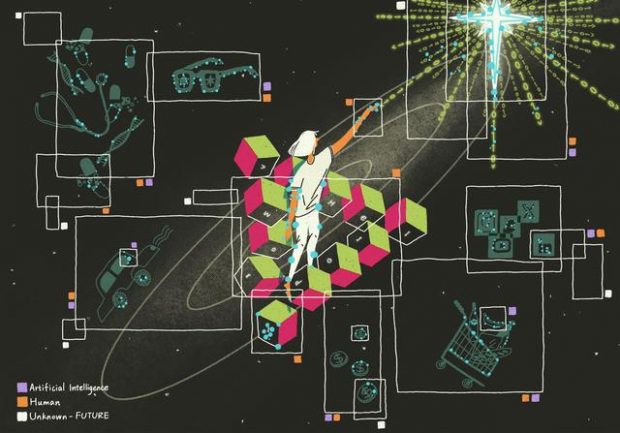
The painting shows a person standing on a staircase made of green and pink cubes, symbolising a Penrose staircase, in a cosmic environment. The person is reaching towards a glowing cross-shaped structure emitting binary code, representing AI's reach into the future. Surrounding the figure are outlined boxes showing various elements, such as glasses, medical tools, a self-driving car, and financial symbols, interconnected by white lines. The background is dark with star-like dots and features colour-coded boxes which mark different elements as relating to AI, human involvement, a combination of both, or an area uncharted by AI and humans.

Developing data governance approaches that prioritise creative communities

Led by Dr Phoenix Perry, University of the Arts London, in collaboration with New York University.  Governance frameworks will be developed that will enable UK and US ...
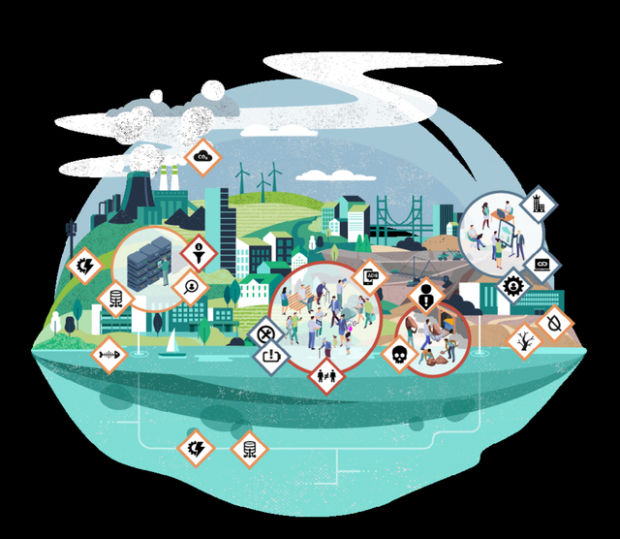
A simplified illustration of urban life near the sea showing groups of people, buildings and bridges, as well as polluting power plants, opencast mining, exploitative work, data centres and wind power stations on a hill. Several small icons indicate destructive processes.

Incentivising responsible AI innovation via harmonised ethical governance approaches

Led by Professor Jingchen Zhao, Nottingham Trent University, in collaboration with Georgia State University.  This project addresses the critical gap between rapid AI innovation ...
This image shows an individual with orange hair interacting with a large, abstract digital mirrored structure. The structure is composed of squares in varying shades of green, orange, white, and black which are pieced together to reflect the individual’s figure. The figure's hand is extended as if pointing to or interacting with the mirrored structure. Behind the structure are streams of binary code (0s and 1s) in orange, flowing towards the digital grid.

Mitigating bias in Automatic Speech Recognition

Led by Professor Jennifer Smith, University of Glasgow, in collaboration with University of California, Berkeley.   Automatic Speech Recognition (ASR), the conversion of spoken ...