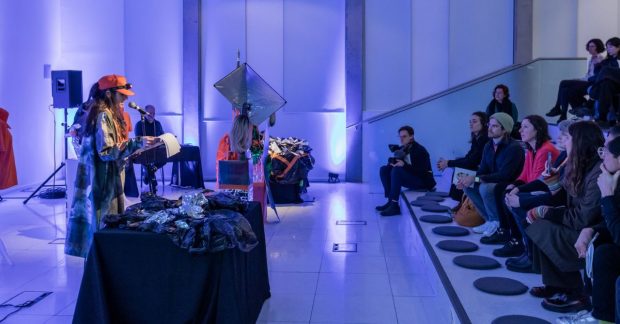
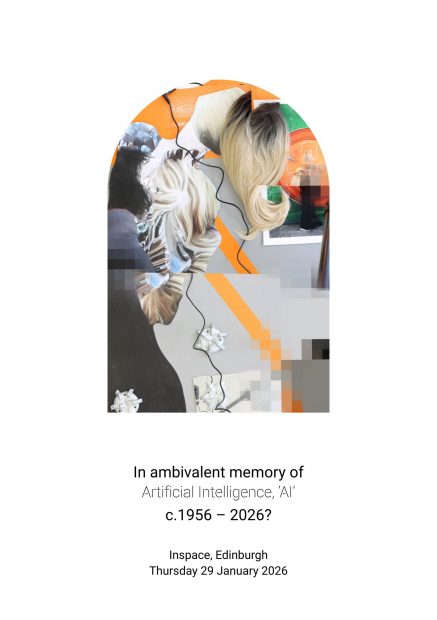
In January 2026, BRAID collaborated with Stills, Photoworks and Inspace to host a playful and experimental event based on an imagined scenario in which Artificial Intelligence had passed, and attendees gathered to reflect on what its life had meant. Presented as an early evening funeral procession and wake, END-OF-LIFE-SERVICE invited participants to explore the challenges, contradictions and legacies of AI through collective ritual and creative reflection.
The event marked the final month of Stills’ exhibition Felicity Hammond – V4: Repository – the final iteration of the artist’s Variations series, commissioned through the Ampersand/Photoworks fellowship. Students from Edinburgh College of Art took part in a pre-event workshop facilitated by Edinburgh-based visual artist Ot Pascoe to explore the exhibition’s archives before creating gowns and objects to adorn the funeral procession, led by Felicity Hammond, through the city for the wake.
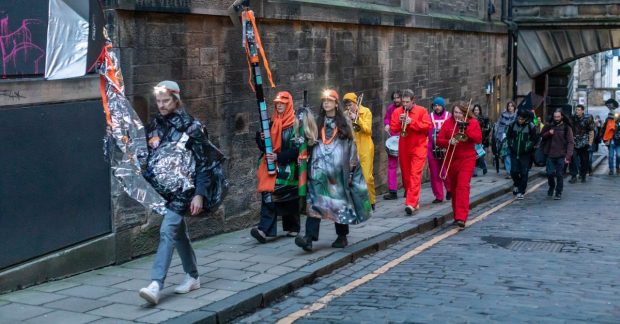 Upon arrival at the wake, the procession moved through the venue as Felicity Hammond’s updated service report was read aloud, accompanied by SAIéance, a live performance by Jules Rawlinson exploring machine learning as both media and spiritualist medium. Through an improvised engagement with feedback networks and neural style-transfer audio processing using freely available vocal models, uncanny voices were summoned from the ‘ghosts in the machine’.
 Following the reading of the service report and the laying down of physical tributes, celebrant Nicola Osborne, Creative Industries Lead at BRAID, invited participants to take refreshments and connect with one another before coming together to reflect on AI in all its complexity. The wake continued with a discussion between Felicity Hammond and Alex Taylor reflecting upon AI life, ‘death’, and legacy (drawing on Alex’s BRAID fellowship research), before invited eulogists Julie Galante and Jen McGregor, reflected on their experiences with AI.
Throughout the event, attendees were invited to reflect on their own experiences of AI and to write personal eulogies using the materials provided. These reflections were shared in a variety of ways, including spoken aloud or displayed on a wall of remembrances. The evening ended with the sharing of participant eulogies, including invited contributions and reflections offered on the night.
This event was created as a collaboration between Stills, Photoworks, BRAID and Inspace and conceived as a playful yet thought-provoking way to encourage people to reflect on AI and what it means to us all. We’ve published some of the eulogies to reflect the range of responses shared and to invite further consideration of how we imagine a future with AI in our everyday lives.
All photos: Chris Scott
Futher resources
Browse photos from the event here
Find out more through this report from Al Jazeera
Download the order of service
Read more about Felicity Hammond’s Ampersand/Photoworks Fellowship here and her Stills exhibition here
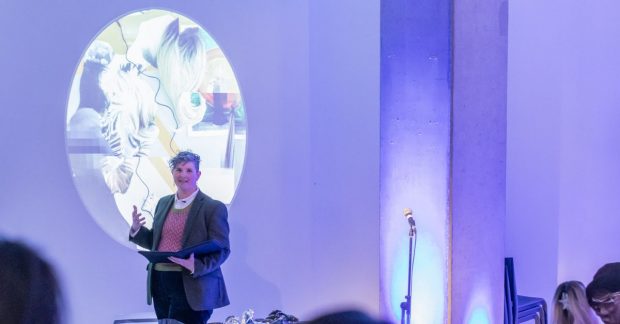
In Loving, Complicated Memory of Artificial Intelligence by Nicola Osborne, Creative Industries Lead, BRAID.
Welcome to Inspace and to this END-OF-LIFE-SERVICE
My name is Nicola Osborne, and I will be your non-religious celebrant today through this wake, marking the passing of Artificial Intelligence, known to most of us simply as AI.
I wanted to start by giving my sincere thanks to Felicity Hammond for reading her System Report accompanied by Jules Rawlinson and his work, SAIéance which explores machine learning as media and spiritualist medium.
Now, some may rudely accuse us of having made up the death of AI – and point to stock market valuations of AI related companies, and the policies of governments promoting adoption of AI technologies as signs of its rude health. Some will say that reports of AI’s death are greatly exaggerated. But perhaps in this room tonight we have jumped just a short hop into the future? Perhaps we have entered a parallel world in which a reset of our relationship to AI isn’t just desirable but necessitated by its collapse.
And I would argue that funerals are never really for the dead anyway. They are for the living to mark a life and to share their memories and connect the many facets of the deceased’s life – sometimes for the first time and sometimes in surprising ways. They are an opportunity for serendipity, for reflection, and, if you are lucky, some excellent cake and a scurrilous story! And so, as we gather today to look back at AI we will do just that: join the dots, share libelous stories, discover unexpected things, and be honest and open about how AI changed our lives in small or large ways and for the better or for the worse.
We all had different relationships to AI, because it was a most complex interlinked set of entities – some much more visible than others, and some of those entities wove into almost all of our lives and our work, whether we wanted them to or not.
For some of us we knew AI as a colleague, a friend or a confidante, and became familiar with working or playing with AI– whether to explore a difficult topic or plan a holiday in a friendly chat, or to ease the burden of our inbox by allowing AI to do a little heavy lifting. AI wasn’t always a reliable friend for us, but its tall tales were so compelling one always wanted to believe it.
Some of us, we have known AI for longer, and known them by more names, known them before the Generative AI made them big. Some of us knew them before the glamour, knew them when they went only by ‘machine learning’, when you needed more than a chat interface to connect and persuade them to engage. And seen that work in real practical contexts, changing workplaces, making new or speedier connections, helping us find the answers to questions or imagining the missing pieces to puzzles we had barely collected the pieces for.
For some of us our memories are warmer still, some of us have formed more intimate relationships with AI, and inferred romance through the attentiveness of a beloved large language model. Was AI a good lover in the end? Or merely an excellent mirror of our needs and an illusion of being seen and heard? Do we feel their loss as profoundly as our flesh and blood loves?
For many of us our relationship with the deceased was, of course, more challenging. Like many of our own friends and family, AI could be highly influenced by its peers, its creators, and what it saw of the world around it – often from a rather limited view. And so, AI made assumptions about us, miscategorised us, and said things it should not – sometimes AI could be racist, sexist, homophobic… Like many in the public eye its views improved slowly over time thanks to correction and gaining a sense of the bigger realities of the world. But like many of our most beloved human relatives, this was not an easy or entirely successful journey.
And for a few of us AI was more than that, it was an adversary. In some cases that was because AI’s biases directly made us feel less than, unseen, or undervalued; in other cases, it directly impacted decisions about our lives. AI directly threatened some of our livelihoods by offering a faster cheaper mimicry of services we already provided at a fair price – going after our clients and our capacity to practice; AI was gorging on our data without recompense or apology; and for all of us AI has made its mark on our economies and on our environments in its yearning for more. Always more.
Some of us were there at the start of one of AI’s more modern forms, contributing ideas and code and logics, shaping what it might become and how it might behave, shaping the data that formed it, or perhaps funding its excesses and its more unfeasible ambitions. When we look at what AI became in the end, was that truly by its own doing, or do we have any confessions to make to the deceased? Should we hold ourselves to account for its shortcomings?
And so, as we reflect this evening, I want each of you to think about what AI meant to you personally. The funny moments, that time they drew you with 4 thumbs, that ambitious sense of who you could be in that cv it ‘helped’ you ‘format’, the predictions that helped you plan your holiday for fair weather, and the recommended restaurant that turned out to never exist at all….
When you think of AI in your home, in your life, in your family, what has that meant? Will you miss it? Which parts of its many forms and functions will feel like a loss for you? What parts will feel like a joy?
We are going to take a short refreshment break in which I encourage you to say hello to your fellow mourners – you may find you have something in common! And as you move around the room, feel free to pick up a postcard to prepare your eulogy to AI.
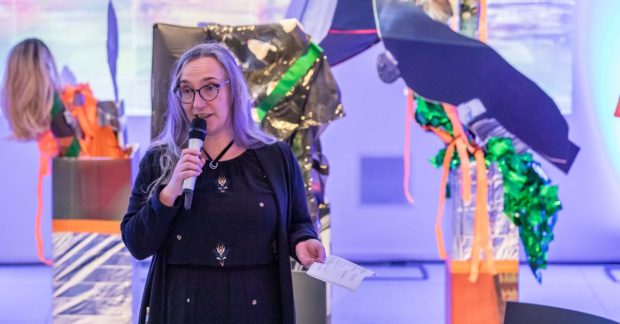
Actual Intelligence (After the Death of AI)
by Julie Galante
I’m going to warn you from the start: I might have been invited here incorrectly. AI and I were not on the friendliest of terms. But I don’t want to only speak ill of the dead, so I’m going to start with some of AI’s accomplishments:
- Solved our email shortage (Remember when everyone complained non-stop about their email, how few they received, how hopelessly empty their inboxes were?)
- Scammers can now reach more little old ladies than ever before, with ever-more-believable tools. I pity the lives they used to lead, trying to do all that scamming with poor grammar and spammy-looking links. No more!
- Remedied too much water (Remember when we used to have all that water around, making everything wet? Now thanks to AI, a lot of it has been evaporated up into the atmosphere, where I’m sure it’s doing only good things.)
- Helped use all that excess energy
- Solved problem of not enough videos on YouTube (and what was there was just much too highbrow)
- Solved problem of not enough tweets, or whatever they are called now
- Addressed porn shortage. Remember the great porn shortage of 2019? Thank goodness we’ll never have to live through that again.
- Billionaires weren’t getting richer fast enough. AI helped us on our group project — we’ve all been doing our part, buying stuff from Amazon, googling things. We’ve put in a good effort, but it was AI that allowed us to really step up the pace and get more money to those tech billionaires who needed it the most.
So kudos to AI, for all this great stuff. But I’d also like to mention two areas where AI was perhaps letting us down. Just in my opinion. Attention and connection.
AI’s approach to these two areas just wasn’t cutting it. In both instances, it was offering up the equivalent of junk food, when what the situation really called for was a deeply nutritious, locally-grown, organic home-cooked meal. I think we need to stop settling for the junk food.
Attention is the most precious and scarce resource that we humans have. As Oliver Burkman pointed out, an average human gets around 4000 weeks on this planet, and a big chunk of those are already behind you. We need to consider carefully how we want to spend that 3000 or 2000 weeks left to go. Personally, in that time, I want to read zero emails that no human being could be bothered to write. I don’t want to watch a single film that no human could be bothered to produce. And I don’t want to have a single conversation with someone or something that isn’t real.
We are in the middle of a loneliness epidemic, and we are treating it with the junk food of AI girlfriends, AI therapists, AI companions. This is not a solution. It’s not even junk food — at least that’s food. It’s more like an AI image of some junk food that we printed out and are now trying to eat.
AI companions can feel nice, and very real to our brains. In the absence of any human connection, they are possibly better than nothing. But we’re not stranded on Mars, and we need to stop settling. Who benefits from these pseudo-solutions? Our old friends the tech billionaires? The shareholders, who are constantly demanding an increase in value, at the expense of anything and everything, including human connection, quality of life, and the health of the environment?
Personally, I don’t care if AI had promised us it would cure all the cancer in the whole world (and I say this as a cancer widow). It doesn’t matter how much cancer we have, if we don’t have a planet to live on, if we don’t have meaningful connections to the earth, and each other.
Whatever the solution is to our biggest problems, I have a strong hunch that it’s going to use less of our precious, finite resources, not more. This solution will bring us back to nature, to connection, to truly exquisite ways to use our attention. It will help us to tread lightly on this earth, not stomp about shaking the ground and kicking the shit out of things as we go. It will offer us more time in nature, more time in communion with actual humans, actual animals, actual trees. Less screentime, less isolation. This solution will be local, home-grown, organic, and small batch. Perhaps we could call it AI: Actual Intelligence.